Not a few doubted the viability of the Civil Code immediately after its entry into force.
Despite this and unlike other similar regulations (for instance, the Civil Procedure Code), the Civil Code, in the ten years since its adoption, has proved remarkably robust and… viable!
Firstly, only four of its articles have been amended through the Parliament’s intervention, namely 658, 1112, 2445 and 2504.
Secondly, only one article was invalidated by the Constitutional Court as contrary to the Fundamental Law, namely Article 164 para. 1, on the grounds that it does not provide adequate safeguards for placing a person under interdiction. A second, interpretative decision held that Article 277 para. 2 and 4 of the Civil Code cannot constitute a basis for refusing to grant the right of residence in the country to same-sex spouses married in a European Union State. A third decision of the Constitutional Court declared an Article of Law no. 71/2011, namely Article 229 para. 3 on the tutorship court, unconstitutional, so it was not a Civil Code text.
Finally, the High Court of Cassation and Justice has delivered only 13 judgments on appeals in the interest of the law, targeting – directly or indirectly – texts from the Civil Code and admitted 7 requests for clarification of legal issues raised by some of the provisions of the Code.
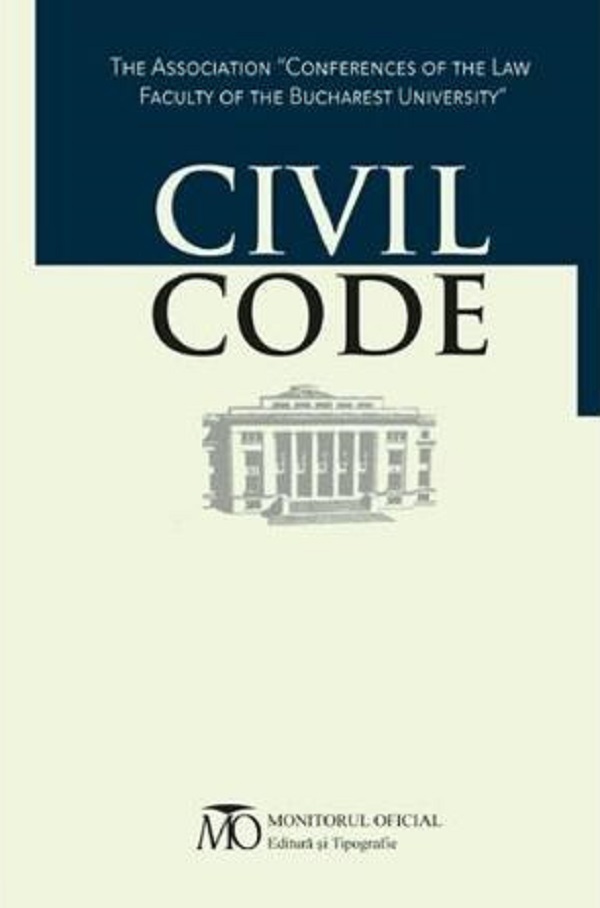
To produce the Romanian Civil Code translated into English, the Association „Conferences of the Law Faculty of the Bucharest University” turned to Monitorul Oficial al Romaniei Publishing House. The editorial team had an exemplary collaboration with the translator, Mrs Oana Gheorghiu, for the final version of the text.
Mrs Oana Gheorghiu used numerous documentary sources, carefully analyzing the different variants of terms and finally choosing the one she considered the most appropriate. In her work she was mainly guided by the English version of the Civil Code of Quebec (a natural choice, given the important role of this Code as a model for the Romanian Civil Code), but she also sometimes resorted to the Civil Code of the State of Louisiana, an English-language code, but – as we know – of French inspiration.
Some novel regulations in the Romanian Civil Code
Remaining a continental Civil Code, anchored in the tradition of Roman law and French law, which marked its predecessor of 1864, the Romanian Civil Code, which was adopted in 2009 and entered into force in 2011, shows solid elements of continuity with the previous Civil Code, but also some of obvious novelty. Since neither the purpose of this presentation nor the space allocated to it allows us to present them, we will only review some of the latter. Thus, the current Civil Code:
a) Unlike the previous legislative framework, which presupposed a Civil Code and a Trade (Commercial) Code, removed the duality civil law – commercial law and took over the „monist” conception of some of the codes that served as its inspiration: the Civil Code of Quebec, the Italian Civil Code, the Swiss Code of Obligations. Thus, the Civil Code applies to all private law subjects, irrespective of their field of activity (Article 3).
b) Provides for the application with priority of international treaties on human rights and European Union law (Articles 4 and 5), in accordance with the provisions of fundamental law (Articles 20 and 148 of the Constitution).
c) Regulates the principle of good faith (Article 14), forbids the abuse of right (Article 15), defines guilt (Article 16) and common and invincible error (Article 17).
d) It naturally brings back the regulation on persons (Book I) and family (Book II), which had been „exiled” as separate normative acts in the communist era.
e) With regard to the patrimonial relations between spouses, it provides for a plurality of matrimonial regimes (Articles 312-372).
f) In property matters it regulates, for the first time in the Civil Code: the action for the recovery of property (Articles 563-566), periodic ownership (Articles 687-692), superficies (Articles 693-702), trust (Articles 773-791), administration of the property of others (Articles 792-857), public ownership (Articles 858-875) and the land register (Articles 876-915).
g) In the field of obligations, the following are also regulated for the first time: unpredictability (Article 1271), assignment of contract (Articles 1315-1320), unilateral juridical acts (Articles 1324-1329), taking over the debt (Articles 1599-1608), restitution of prestations (Articles 1635-1649), autonomous guarantees (Articles 2321-2322), movable hypothec (Articles 2387-2419 and 2435-2477).
Editie ingrijita de: Flavius-Antoniu Baias.
Codul cartii: MOO978-606-035-077-4-