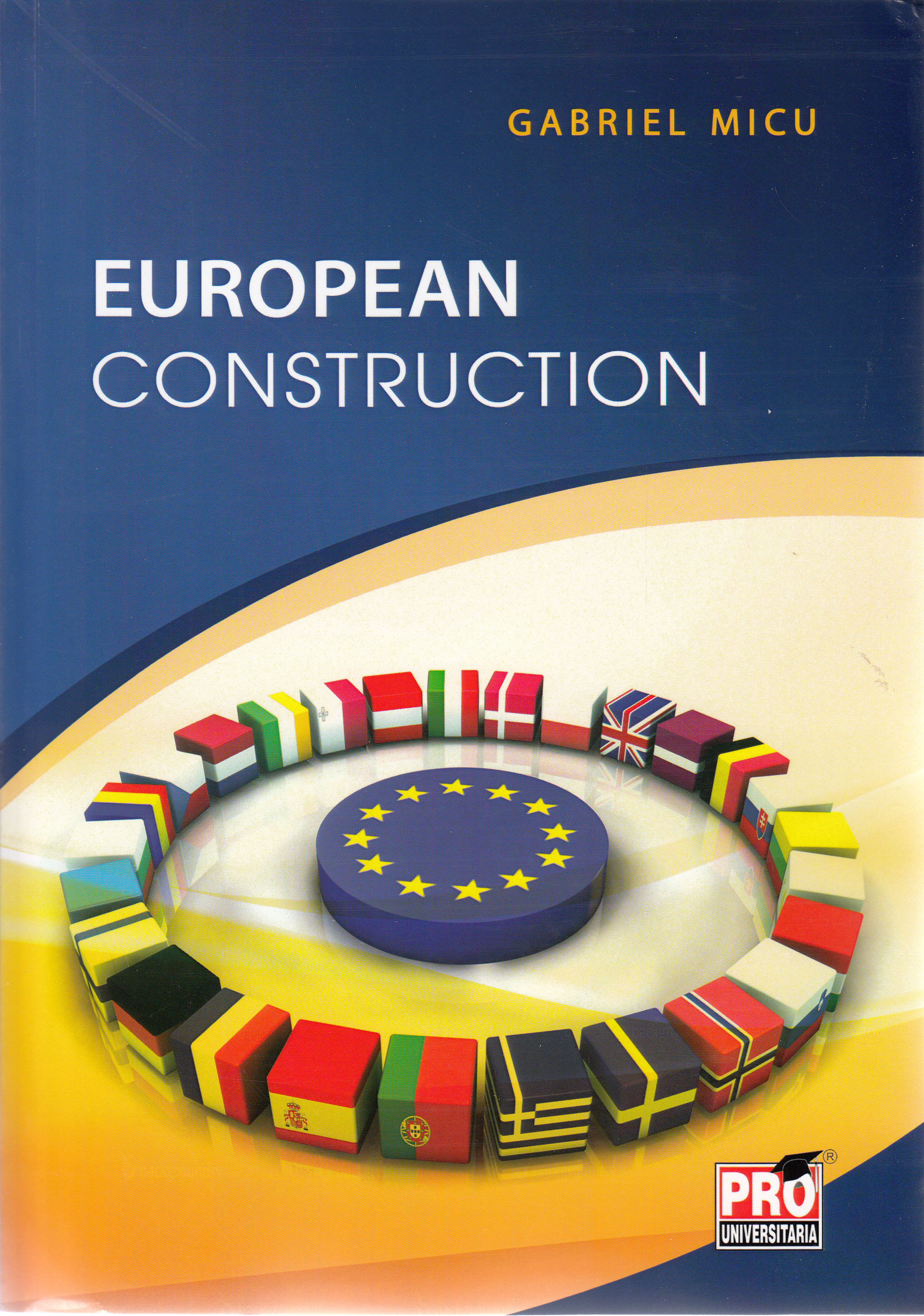
„The study European Construction represents a juridical-political approach of an important thematic for Romania. The originality of the work stems not necessarilyfrom the content of the public information regarding the mechanisms of functioning of the community construction, but rather from the manner in which the work is structured, such as to highlight the authors view on the content of the European unity idea, in general.
The reasoning used to sustain the logic of edification of the community construction is diversified, starting with historical aspects and reaching those of a geopolitical nature, explaining the mechanisms that underlie the functioning of community architecture, while at the same time having a deepened approach, by means of juridical sciences. Following the logical path proposed by the author, it becomes obvious that he did not attempt a detailed analysis of the institutional structure, of the European Union, but had as a primordial purpose highlighting the juridical-political mechanisms that put in motion the European construction in its whole, as well as the manner of interaction of European institutions, among themselves, as well as with member states, in order to aid the Union in reaching the objectives proposed through Treaty by member states.
In the part dedicated to historical argumentation, underlying the contouring of Europe today, most appreciated can be the authors effort to highlight the representative elements that will come together in a logical, coherent construction of the existence, since the earliest times, of more or less motivated European unification tendencies. Presenting in a chronological fashion the manner in which these tendencies have manifested throughout different historical periods, the author underlines the fact that at the present, the European construction is based on economical and political grounds, from a juridical point of view it being substantiated as a distinct entity.
The substantiation of the idea that Europe has become more than a simple geographical delineation, in time becoming a veritable geopolitical concept, is also encompassed in this context. The historical and political natured elements presented in this work succeed in creating an ensemble image of the rationales underlying the decision of member states with regards to the establishment and evolution of the community construction. In the same succinct, but at the same time clear manner, the author systematizes and formulates in his own logic, the principles that based the community construction, at the same time stating the novelty elements brought by them as opposed to classical international law. The manner in which, utilizing a set of original juridical instruments, as well as novelty decision-making mechanism, European institutions elaborate those norms whose ensemble represents the community legal order.
In conclusion, I wish to highlight the quality of this works content, especially varied and at the same time current, with regards to the structure, the functioning and the evolution of the community construction, as well as the consistent bibliography employed by the author. The presentation of the functioning mechanisms, as well as of the instruments utilized by institutions of the European Union is realized in a logical, fluent manner, easily covered by the reader, shaping a clear, comprehensive picture of the juridical and political elements existing in the European architecture, created by member states, through the agreement of their sovereign will.
It must be stated that at the basis of this work lies the course entitled Community Institutional Legal Order, published by the author in the year 2007, completed and modified in accordance with the evolutions recorded by the community construction up to the beginning of the year 2013. Considering those mentioned, it is my belief that this work addresses a wide spectrum of readers, connoisseurs, but also those taking their first steps in unveiling the addressed issue.” – Ph.D. Professor. Ion M. ANGHEL
The reasoning used to sustain the logic of edification of the community construction is diversified, starting with historical aspects and reaching those of a geopolitical nature, explaining the mechanisms that underlie the functioning of community architecture, while at the same time having a deepened approach, by means of juridical sciences. Following the logical path proposed by the author, it becomes obvious that he did not attempt a detailed analysis of the institutional structure, of the European Union, but had as a primordial purpose highlighting the juridical-political mechanisms that put in motion the European construction in its whole, as well as the manner of interaction of European institutions, among themselves, as well as with member states, in order to aid the Union in reaching the objectives proposed through Treaty by member states.
In the part dedicated to historical argumentation, underlying the contouring of Europe today, most appreciated can be the authors effort to highlight the representative elements that will come together in a logical, coherent construction of the existence, since the earliest times, of more or less motivated European unification tendencies. Presenting in a chronological fashion the manner in which these tendencies have manifested throughout different historical periods, the author underlines the fact that at the present, the European construction is based on economical and political grounds, from a juridical point of view it being substantiated as a distinct entity.
The substantiation of the idea that Europe has become more than a simple geographical delineation, in time becoming a veritable geopolitical concept, is also encompassed in this context. The historical and political natured elements presented in this work succeed in creating an ensemble image of the rationales underlying the decision of member states with regards to the establishment and evolution of the community construction. In the same succinct, but at the same time clear manner, the author systematizes and formulates in his own logic, the principles that based the community construction, at the same time stating the novelty elements brought by them as opposed to classical international law. The manner in which, utilizing a set of original juridical instruments, as well as novelty decision-making mechanism, European institutions elaborate those norms whose ensemble represents the community legal order.
In conclusion, I wish to highlight the quality of this works content, especially varied and at the same time current, with regards to the structure, the functioning and the evolution of the community construction, as well as the consistent bibliography employed by the author. The presentation of the functioning mechanisms, as well as of the instruments utilized by institutions of the European Union is realized in a logical, fluent manner, easily covered by the reader, shaping a clear, comprehensive picture of the juridical and political elements existing in the European architecture, created by member states, through the agreement of their sovereign will.
It must be stated that at the basis of this work lies the course entitled Community Institutional Legal Order, published by the author in the year 2007, completed and modified in accordance with the evolutions recorded by the community construction up to the beginning of the year 2013. Considering those mentioned, it is my belief that this work addresses a wide spectrum of readers, connoisseurs, but also those taking their first steps in unveiling the addressed issue.” – Ph.D. Professor. Ion M. ANGHEL
Codul cartii: PUN978-606-26-0542-1