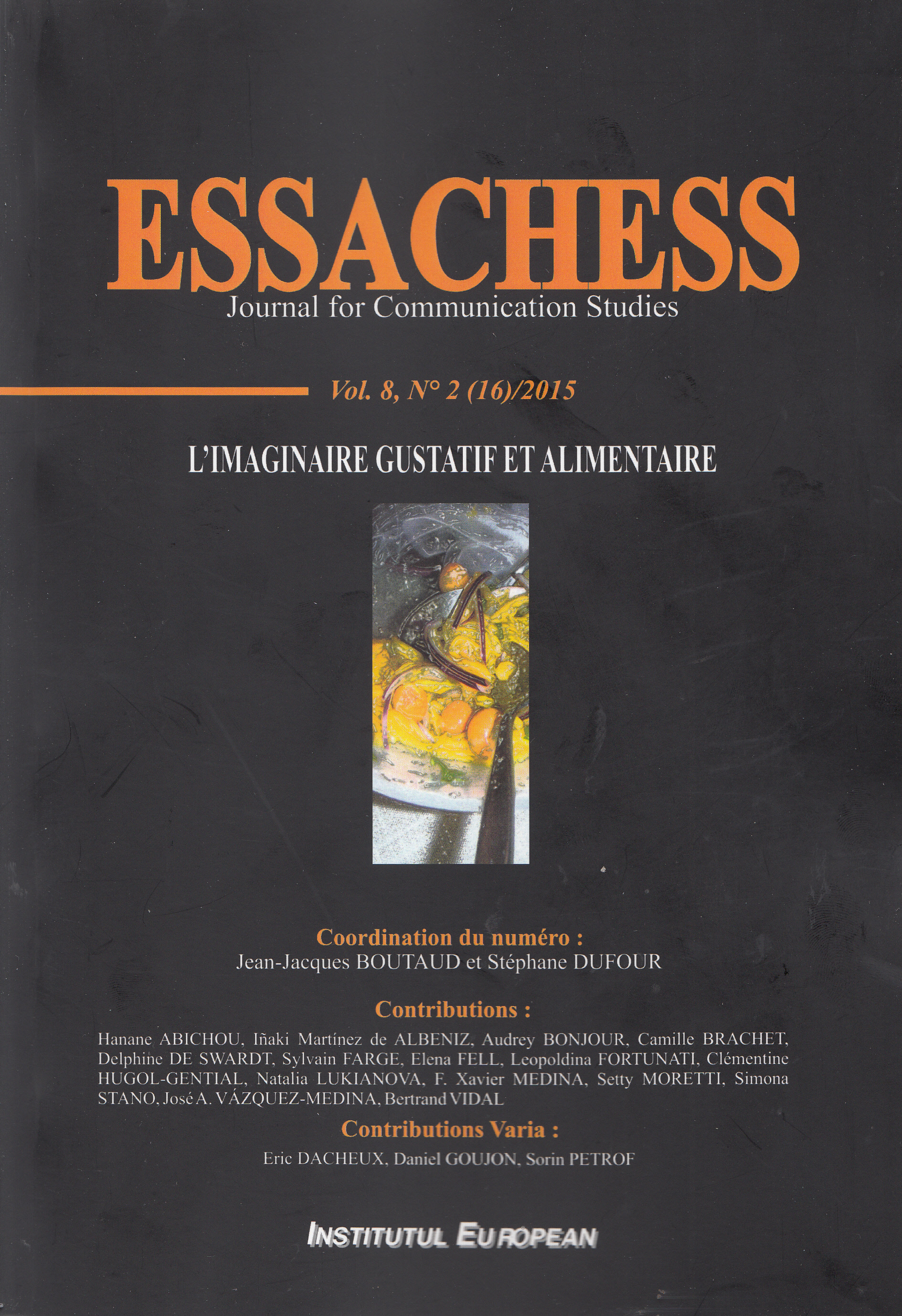
Ce numero d’Essachess s’organise autour d’un triptyque essentiellement construit sur des fondations imaginaires : (I) manger du signe, produire du sens, cinq articles dont l’empan s’ouvre des aromes et saveurs, aux aliments, la cuisine, la gastronomie ; pour les deux autres volets, une evidente charpente ontologique autour de l’espace et du temps : (II) Carte du gout, territoires de l’imaginaire, ou la question des lieux est envisagee a differentes echelles et sous differents regimes de representation, espaces physiques ou cartes mentales ; enfin, (III) Parcours du gout, du matin du monde au soir de la vie, des premiers stades de l’incorporation aux imaginaires angoisses et mortiferes d’une temporalite de survie alimentaire.
Sommaire:
Sommaire:
? Manger du signe, produire du sens
? The recipe: the queen of pragmatics. An Italian case study
? The Candy Project: the re-enchantment of candy in a liquid world
? Role du tourisme culturel dans le marketing des produits traditionnels de terroir et leur reputation : cas du sud tunisien
? L’allaitement maternel : analyse semiotique et approche educommunicationnelle
? Quand la bise fut venue. L’imaginaire alimentaire de la subculture survivaliste
Fragment:
Foreword
Foreword in the phenomenon of fast food, the rich semantics of food consumption seems to be absent from the gastronomic experience: there is no shared meal with its communicative potential; the time which would be spent on food preparation is extracted from one’s lived time and diverted to other practices such as work, education or entertainment; the material component of the gastronomic environment is impoverished as traditional dishes and cutlery are replaced with disposable counterparts.
Nevertheless, fast food is immensely popular. It could be said that fast food signifies the abundance and accessibility of food the humankind’s dream come true which could be understood as a result of us exercising control over nature. Fast food, along with the car and maybe Hollywood blockbusters, has become a symbol not only of the American way of life; it marks a specific standard of civilized living, which appeals to most people. But what exactly makes hamburgers and coke, these symbols of globalization in the field of nutrition, so attractive?
Fast food appears to transcend the basic binary opposition, whereby food of one’s own culture is opposed to the food of another culture. Fast food is universal and democratic. Fast food has a high calorific value and requires a minimum of time for consumption, or utilization. This type of food can be found in any society when a certain group of people, often engaged in physical labour, devalues the rich semantics of a ceremonial meal by reducing it to the value of the fuel for the body.
This paper explores the semiotics of visual imagery associated with fast food and advertising of fast food focussing on visual processes that influence the development of the contemporary gastronomic culture.
Codul cartii: INE2066-5086-92