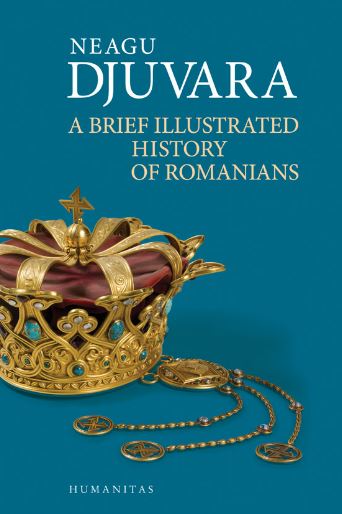
This is not an ordinary history book. As readers will realise quite early on, Neagu Djuvara has the audacity to tackle some of the most delicate and controversial issues in Romanian history under the guise of light storytelling. With the addition of illustrations, the book becomes better and easier to understand: we are offered the chance to see how ancient artefacts discovered by archaeologists actually look like, or catch a glimpse of the world of barbarians and medieval warriors depicted in wonderful illuminated manuscripts. As we get nearer to the modern age, the imagery becomes even richer and we get to know Romania’s princes and monarchs, their allies and their enemies, the politicians good and bad their triumphs, tribulations or even tragedies; and sometimes even the common people going about their daily lives. The photographic discourse focuses on the most important documents, even if their condition is not optimal.
You will also find images of pottery, jewellery and weaponry, some of them from unexpected sources, often unknown to the public, accompanied by detailed captions that complement the information provided in the text itself. Together, the story and illustrations intertwine to form a new, enhanced historical account – and hopefully, one not lacking in originality.
Fragment din volumul „A Brief Illustrated History of Romanians” de Neagu Djuvara:
II. THE DAWN OF THE ROMAN MEDIEVAL STATES
Was there a „dismounting”? And so we find ourselves at the end of the 13th century, the crucial moment when the first organised Romanian state emerged between the Carpathians and the Danube: Wallachia. It may seem strange, but the circumstances surrounding this major event have remained obscured enough to cause serious controversy between historians: was there a „dismounting” like tradition demands, of the legendary Negru Voda from the land of Fagaras? Or was the unification of the voivodeships south of the Carpathians a local phenomenon? Also, who was Basarab I the Founder, Great Voivode?
I mentioned earlier that the avalanche that was the Mongol invasion, which had destroyed or severely weakened almost every polity in central and Eastern Europe, had also created favourable conditions for the voivodeships in Wallachia to shrug off some of the Hungarian pressure and achieve the political unity of all those speaking Romanian between the mountains and the Danube for the very first time. This happened around the year 1300. Later chronicles, from the 16th and 17th centuries, mention the traditional date of 1290. However, most contemporary historians tend to indicate a later date, after 1300; there is even a group of historians, unfortunately in the majority, who claim that the dismounting tradition, with Negru Voda crossing over from Fagaras, is purely an invention from the 17th century, with no grounding in historical reality.
Nevertheless, a few outstanding historians, such as Gheorghe Bratianu or Serban Papacostea, have recently spoken against this theory, asserting that oral tradition contains a grain of truth. I definitely stand with them in this attempt to rehabilitate the old legend, and moreover, I am convinced that Basarab the Founder, our firstever recorded ruler, was descended from a lineage of Cuman chieftains.
Codul cartii: HUM978-973-50-5875-3-